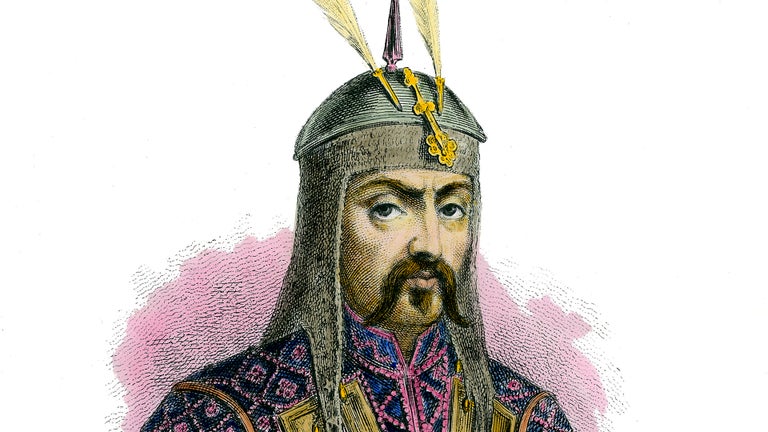
pascalaubier.com – Genghis Khan, born Temüjin, is a name that resonates through the annals of history as one of the most formidable conquerors the world has ever known. His rise from a young boy, abandoned and left to fend for himself on the harsh Mongolian steppe, to the emperor of the largest contiguous empire in history is a tale of ambition, strategy, and unparalleled leadership. Genghis Khan’s legacy is not just one of conquest but also of unification, law, and governance, transforming the nomadic tribes of the Mongolian steppe into a formidable empire.
Early Life and Rise to Power
Born around 1162, Temüjin’s early life was marked by tragedy, betrayal, and resilience. The murder of his father, Yesügei, left the young Temüjin and his family vulnerable to enemies and the harsh realities of the steppe. Despite these challenges, Temüjin’s determination and leadership qualities began to emerge as he navigated the complex politics of the Mongol tribes, seeking allies and consolidating power.
His journey to becoming Genghis Khan, a title meaning “universal ruler” or “oceanic ruler,” was marked by numerous battles and strategic alliances. In 1189, Temüjin was elected as the khan of his tribe, the Borjigin, and over the next two decades, he would embark on a series of military campaigns that would see him unite the nomadic tribes of the Mongolian steppe under his banner.
Unification of the Mongol Tribes
Genghis Khan’s ability to unite the fractious and often warring Mongol tribes was a testament to his leadership and vision. He introduced a set of laws known as the Yassa, which governed everything from military conduct to trade and personal conduct. This legal code helped to create a sense of unity among the diverse tribes, fostering a collective identity as Mongols.
His military innovations also played a crucial role in his success. Genghis Khan reorganized the Mongol army into a highly mobile and disciplined force, structured in units of thousands and tens of thousands, regardless of tribal affiliations. This not only increased the army’s efficiency but also further diminished tribal loyalties, fostering a sense of loyalty to Genghis Khan himself.
Empire Building
By 1206, Genghis Khan had successfully united the Mongol tribes and was officially proclaimed Genghis Khan at a grand assembly known as the Kurultai. From this point, his ambitions turned to expansion. Over the next two decades, the Mongol Empire would grow to encompass much of Asia and Eastern Europe, stretching from the Pacific Ocean to the Danube River.
Genghis Khan’s conquests were not just about territorial expansion; they were also about establishing a system of governance that could sustain the vast empire. He introduced a network of roads and relays, known as the Yam, which facilitated rapid communication across the empire. He also encouraged trade and cultural exchange, making the Mongol Empire a melting pot of different cultures and religions.
Legacy
Genghis Khan’s death in 1227 did not mark the end of his empire; instead, his descendants continued to expand its borders, reaching its zenith under the reign of Kublai Khan, who established the Yuan Dynasty in China. Genghis Khan’s legacy, however, extends beyond the borders of the empire he built. He is remembered as a leader who transformed the nomadic tribes of the Mongolian steppe into a formidable empire, introducing laws and systems of governance that were ahead of his time.
His impact on the world was profound, facilitating trade and cultural exchange across Eurasia and laying the foundations for the Silk Road. Genghis Khan’s story is a testament to the power of vision, leadership, and the indomitable human spirit.
In conclusion, Genghis Khan’s legacy as the Mongol emperor who united the steppe is a complex tapestry of conquest, governance, and innovation. His ability to transform a fractious group of nomadic tribes into a unified and powerful empire is a testament to his leadership and vision. Genghis Khan’s story continues to fascinate and inspire, reminding us of the profound impact one individual can have on the course of history.